| Day | Section | Topic |
|---|---|---|
| Mon, Jan 12 | 1.2 | Data tables, variables, and individuals |
| Wed, Jan 14 | 2.1.3 | Histograms & skew |
| Fri, Jan 16 | 2.1.5 | Boxplots |
Today we covered data tables, individuals, and variables. We also talked about the difference between categorical and quantitative variables.
In the data table in the example above, who or what are the individuals? What are the variables and which are quantitative and which are categorical?
If we want to compare states to see which are safer, why is it better to compare the rates instead of the total fatalities?
What is wrong with this student’s answer to the previous question?
Rates are better because they are more precise and easier to understand.
I like this incorrect answer because it is a perfect example of bullshit. This student doesn’t know the answer so they are trying to write something that sounds good and earns partial credit. Try to avoid writing bullshit. If you catch yourself writing B.S. on one of my quizzes or tests, then you can be sure that you a missing a really simple idea and you should see if you can figure out what it is.
We talked briefly about making bar charts for categorical data.
Then we introduced stem & leaf plots (stemplots) and histograms for quantitative data. We started by making a stemplot and a histogram for the weights of the students in the class. We also talked about how to tell if data is skewed left or skewed right.
Can you think of a distribution that is skewed left?
Why isn’t this bar graph from the book a histogram?
Then we did this workshop:
We finished by reviewing the mean and the median.
The median of numbers is located at position .
The median is not affected by skew, but the average is pulled in the direction of the skew. So the average will be bigger than the median when the data is skewed right, and smaller when the data is skewed left.
We introduced the five number summary and box-and-whisker plots (boxplots). We also talked about the interquartile range (IQR) and how to use the rule to determine if data is an outlier.
We started with this simple example:
An 8 man crew team actually includes 9 men, the 8 rowers and one coxswain. Suppose the weights (in pounds) of the 9 men on a team are as follows:
120 180 185 200 210 210 215 215 215Find the 5-number summary and draw a box-and-whisker plot for this data. Is the coxswain who weighs 120 lbs. an outlier?
| Day | Section | Topic |
|---|---|---|
| Mon, Jan 19 | Martin Luther King day - no class | |
| Wed, Jan 21 | 2.1.4 | Standard deviation |
| Fri, Jan 23 | 4.1 | Normal distribution |
Today we talked about robust statistics such as the median and IQR that are not affected by outliers and skew. We also introduced the standard deviation. We did this one example of a standard deviation calculation by hand, but you won’t ever have to do that again in this class.
11 students just completed a nursing program. Here is the number of years it took each student to complete the program. Find the standard deviation of these numbers.
3 3 3 3 4 4 4 4 5 5 6From now on we will just use software to find standard deviation. In
a spreadsheet (Excel or Google Sheets) you can use the
=STDEV() function.
Which of the following data sets has the largest standard deviation?
We finished by looking at some examples of histograms that have a shape that looks roughly like a bell. This is a very common pattern in nature that is called the normal distribution.
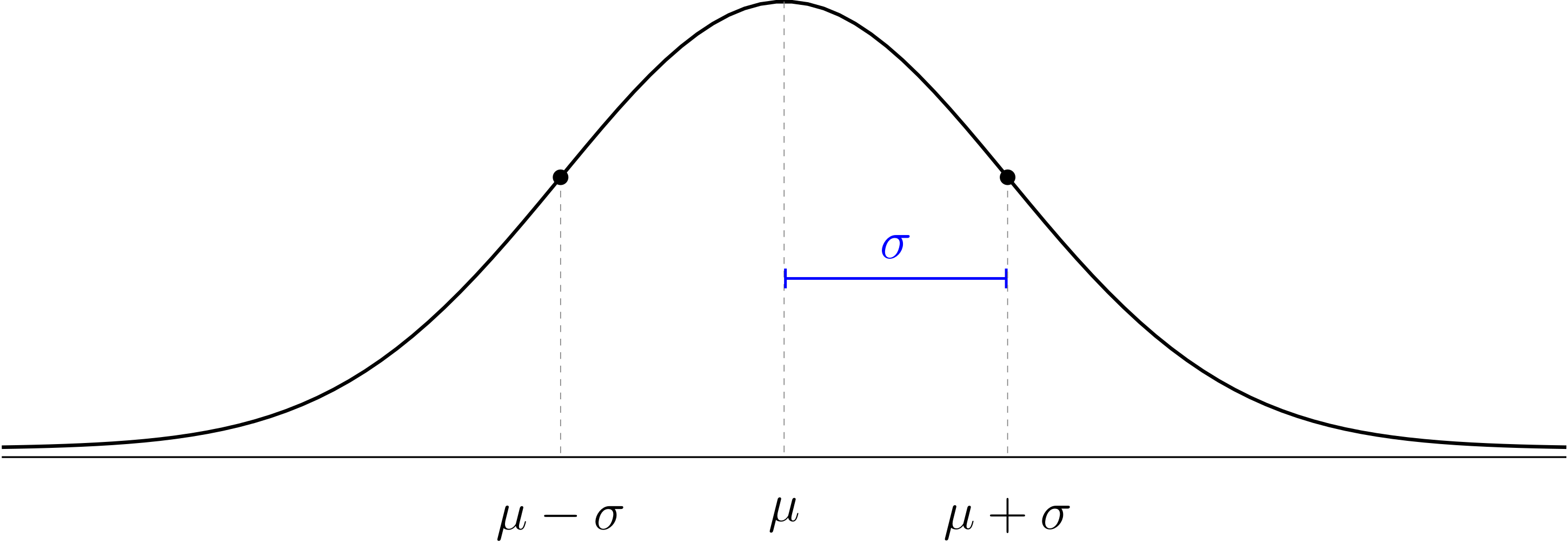
The normal distribution is a mathematical model for data with a histogram that is shaped like a bell. The model has the following features:
The normal distribution is a theoretical model that doesn’t have to perfectly match the data to be useful. We use Greek letters and for the theoretical mean and standard deviation of the normal distribution to distinguish them from the sample mean and standard deviation of our data which probably won’t follow the theoretical model perfectly.
We talked about z-values and the 68-95-99.7 rule.
We also did these exercises before the workshop.
In 2020, Farmville got 61 inches of rain total (making 2020 the second wettest year on record). How many standard deviations is this above average?
The average high temperature in Anchorage, AK in January is 21 degrees Fahrenheit, with standard deviation 10. The average high temperature in Honolulu, HI in January is 80°F with σ = 8°F. In which city would it be more unusual to have a high temperature of 57°F in January?
| Day | Section | Topic |
|---|---|---|
| Mon, Jan 26 | 4.1.5 | No class (snow day) |
| Wed, Jan 28 | 4.1.4 | Normal distribution computations |
| Fri, Jan 30 | 2.1, 8.1 | Scatterplots and correlation |
We introduced how to find percentages on a normal distribution for locations that aren’t exactly one, two, or three standard deviations away from the mean. I strongly recommend downloading the Probability Distributions app (android version, iOS version) for your phone.
We talked about how to use the app to solve the following types of problem:
(Percent below) SAT verbal scores are roughly normally distributed with mean μ = 500, and σ = 100. Estimate the percentile of a student with a 560 verbal score.
(Percent above) What percent of students get above a 560 verbal score on the SATs?
(Percent between) What percent of men are between 6 and 6 and a half feet tall?
(Percent to locations) What is the height of a man in the 25th percentile?
We also talked about the shorthand notation which literally means “the probability that the outcome X is between 72 and 78”. Then we did this workshop.
We introduced scatterplots and correlation coefficients with these examples:
Important concept: correlation does not change if you change the units or apply a simple linear transformation to the axes. Correlation just measures the strength of the linear trend in the scatterplot.
Another thing to know about the correlation coefficient is that it only measures the strength of a linear trend. The correlation coefficient is not as useful when a scatterplot has a clearly visible nonlinear trend.
After we finished that, we talked about explanatory & response variables (see section 1.2.4 in the book).
An article in the journal Pediatrics found an association between the amount of acetaminophen (Tylenol) taken by pregnant mothers and ADHD symptoms in their children later in life. What are the variables? Which is explanatory and which is response?
Does your favorite team have a home field advantage? If you wanted to answer this question, you could track the following two variables for each game your team plays: Did your team win or lose, and was it a home game or away. Which of these variables is explanatory and which is response?
| Day | Section | Topic |
|---|---|---|
| Mon, Feb 2 | 8.2 | Least squares regression introduction |
| Wed, Feb 4 | 8.2 | Least squares regression practice |
| Fri, Feb 6 | 1.3 | Sampling: populations and samples |
We talked about least squares regression. The least squares regression line has these features:
You won’t have to calculate the correlation or the standard deviations and , but you might have to use them to find the formula for a regression line.
We looked at these examples:
Keep in mind that regression lines have two important applications.
It is important to be able to describe the units of the slope.
What are the units of the slope of the regression line for predicting BAC from the number of beers someone drinks?
What are the units of the slope for predicting someone’s weight from their height?
We also introduced the following concepts.
The coefficient of determination represents the proportion of the variability of the -values that follows the trend line. The remaining represents the proportion of the variability that is above and below the trend line.
Regression to the mean. Extreme -values tend to have less extreme predicted -values in a least squares regression model.
Before the workshop, we started with this warm-up exercise.
A sample of 20 college students looked at the relationship between foot print length (cm) and height (in). The sample had the following statistics:
We talked about the difference between samples and populations. The central problem of statistics is to use sample statistics to answer questions about population parameters.
We looked at an example of sampling from the Gettysburg address, and we talked about the central problem of statistics: How can you answer questions about the population using samples?
The reason this is hard is because sample statistics usually don’t match the true population parameter. There are two reasons why:
We looked at this case study:
Important Concepts
Bigger samples have less random error.
Bigger samples don’t reduce bias.
The only sure way to avoid bias is a simple random sample.
| Day | Section | Topic |
|---|---|---|
| Mon, Feb 9 | 1.3 | Bias versus random error |
| Wed, Feb 11 | Review | |
| Fri, Feb 13 | Midterm 1 |
We did this workshop.
| Day | Section | Topic |
|---|---|---|
| Mon, Feb 16 | 1.4 | Randomized controlled experiments |
| Wed, Feb 18 | 3.1 | Defining probability |
| Fri, Feb 20 | 3.1 | Multiplication and addition rules |
One of the hardest problems in statistics is to prove causation. Here is a diagram that illustrates the problem.
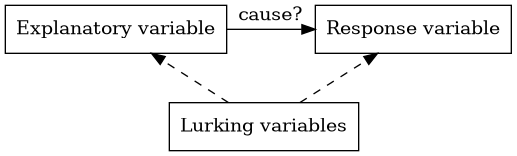
The explanatory variable might be the cause of a change in the response variable. But we have to watch out for other variables that aren’t part of the study called lurking variables. When researchers take a variable into account in a study, we say it is controlled.
We say that correlation is not causation because you can’t assume that there is a cause and effect relationship between two variables just because they are strongly associated. The association might be caused by lurking variables or the causal relationship might go in the opposite direction of what you expect.
An experiment is a study where individuals are put into different treatment groups. An experiment is randomized if the individuals are randomly assigned to the treatment groups. An observational study is one where the researchers do not place the individuals into different treatment groups.
We looked at these examples.
A study tried determine whether cellphones cause brain cancer. The researchers interviewed 469 brain cancer patients about their cellphone use between 1994 and 1998. They also interviewed 469 other hospital patients (without brain cancer) who had the same ages, genders, and races as the brain cancer patients.
In 1954, the polio vaccine trials were one of the largest randomized controlled experiments ever conducted. Here were the results.
We talked about why the polio vaccine trials were double blind and what that means.
Here is one more example we didn’t have time for:
Do magnetic bracelets work to help with arthritis pain?
We finished by talking about anecdotal evidence.
Today we introduced probability models which always have two parts:
A subset of the sample space is called an event. We already intuitively know lots of probability models, for example we described the following probability models:
Flip a coin.
Roll a six-sided die.
If you roll a six-sided die, what is
The proportion of people in the US with each of the four blood types is shown in the table below.
| Type | O | A | B | AB |
|---|---|---|---|---|
| Proportion | 0.45 | 0.40 | 0.11 | ? |
What is
Today we talked about the multiplication and addition rules for probability. We also talked about independent events and conditional probability. We started with these examples.
Then we did this workshop:
| Day | Section | Topic |
|---|---|---|
| Mon, Feb 23 | 3.4 | Weighted averages & expected value |
| Wed, Feb 25 | 3.4 | Random variables |
| Fri, Feb 27 | 7.1 | Sampling distributions |
Today we talked about weighted averages. To find a weighted average:
We did this workshop.
Before that, we did some examples.
Calculate the final grade of a student who gets an 80 quiz average, 72 midterm average, 95 project average, and an 89 on the final exam.
Eleven nursing students graduated from a nursing program. Four students completed the program in 3 years, four took 4 years, two took 5 years, and one student took 6 years to graduate. Express the average time to complete the program as a weighted average.
The expected value (also known as the theoretical average) is the weighted average of the outcomes in a probability model, using the probabilities as the weights.
The Law of Large Numbers. When you repeat a random experiment many times, the sample mean tends to get closer to the theoretical average .
We started with this warm-up problem.
After that we introduced the binomial distribution which is the distribution of the possible number of successes if you do N independent random trials that each have a probability p of a success.
Suppose you play 100 games of roulette and bet on 7 every time. Use the binomial distribution app to find the probability that you win more money than you lose.
What about playing 100 games and betting on black every time? Which is a better strategy?
The binomial distribution is an example of a discrete distribution which means that there are only finitely many possible outcomes between any two values. The normal distribution is an example of a continuous distribution which can have an infinite range of possible outcomes between two values.
Every probability distribution can be described by three things:
We usually won’t calculate the theoretical standard deviation of a probability model by hand. But, there are nice formulas for the theoretical mean and standard deviation of a binomial distribution.
Binomial distribution. The total number of successes in independent trials with a fixed probability of a success on each trial has a binomial distribution with
If both and (i.e., there are at least 10 possible outcomes above and below ), then the binomial distribution is approximately normal.
We finished by talking about the trade-off between risk () versus expected returns () when investing.
Suppose we are trying to study a large population with mean and standard deviation . If we take a random sample, the sample mean is a random variable and its probability distribution is called the sampling distribution of . Assuming that the population is large and our sample is a simple random sample, the sampling distribution always has the following features:
Sampling Distribution of .
Examples of sampling distributions.
Every week in the Fall there are about 15 NFL games. In each game, there are about 13 kickoffs, on average. So we can estimate that there might be about 200 kickoffs in one week of NFL games. Those 200 kickoffs would be a reasonably random sample of all NFL kickoffs. Describe the sampling distribution of the average kickoff distance.
The average American weighs lbs. with a standard deviation of lbs. If an airplane is designed to seat 22 passengers, what is the probability that the combined weight of the passengers would be greater than 4,000 lbs? Hint: This is the same as finding
| Day | Section | Topic |
|---|---|---|
| Mon, Mar 2 | 5.1 | Sampling distributions for proportions |
| Wed, Mar 4 | 5.2 | Confidence intervals for a proportion |
| Fri, Mar 6 | 5.2 | Confidence intervals for a proportion - con’d |
We started with this warm-up problem which is a review of the things we talked about last week.
Annual rainfall totals in Farmville are approximately normal with mean 44 inches and standard deviation 7 inches.
How likely is a year with more than 50 inches of rain?
How likely is a whole decade with average annual rainfall over 50 inches?
Then we talked about sample proportions which are denoted and can be found using the formula In a SRS from a large population, is random with a sampling distribution that has the following features.
Sampling Distribution of .
We did the following exercises in class.
This semester, 7 out of 25 students in my statistics class were born in VA. Is a statistic or a parameter? Should you denote it as or ?
In the United States about 7.2% of people have type O-negative blood, so they are universal donors. Is 7.2% a parameter () or a statistic ()?
If a hospital has patients, describe the sampling distribution for the proportion of patients who are universal donors.
Find the probability that .
About one third of American households have a pet cat. If you randomly select households, describe the sampling distribution for the proportion that have a pet cat.
According to a 2006 study of 80,000 households, 31.6% have a pet cat. Is 31.6% a statistic or a parameter? Would it be better to use the symbol or to represent it?
Today we talked about confidence intervals for proportions. These are based on a simple idea: there is a 95% chance that the sample proportion is no more than 2 standard deviations away from the true population proportion .
Confidence Interval for a Proportion. To estimate a population proportion, use
Works best if there are at least 15 “successes” and 15 “failures” in the sample.
The variable is called the critical z-value is determined by the desired confidence level. Here are some common choices.
| Confidence Level | 90% | 95% | 99% | 99.9% |
|---|---|---|---|---|
| Critical z-value () | 1.645 | 1.96 | 2.576 | 3.291 |
In order to trust a confidence interval, you need these two assumptions to hold:
No Bias. The data should come from a simple random sample to avoid bias.
Normality. The sample size must be large enough for to be normally distributed. A rule of thumb (the success-failure condition) is that you should have at least 15 “successes” and 15 “failures” in the sample.
We did the following examples in class.
In our class 7 out of 25 students were born in VA. Use the 95% confidence interval formula to estimate the percent of all HSC students that were born in VA.
In 2004 the General Social Survey found 304 out 977 Americans always felt rushed. Find the 90% confidence interval for the proportion of Americans who always feel rushed.
What are we 90% sure is true about the confidence interval we found? Only one of the following is the correct answer. Which is it?
A confidence interval has two parts: a best guess estimate (or point estimate) before the plus/minus symbol, and a margin of error after the symbol.
Last time we introduced confidence intervals for proportions. Today we did some more examples related to confidence intervals.
A 2017 Gallop survey of 1,011 American adults found that 38% believe that God created man in his present form. Find a 95% confidence interval to estimate the percent of all Americans who share this belief.
About one third of American households have a pet cat. How large of a sample would be need if you wanted to make a 95% confidence interval with a margin of error less than 1% for the percent of households with a pet cat?
One of our first examples of sampling was the Literary Digest magazine poll from the 1936 presidential election. They had a huge sample with 2.4 million responses. In that sample, 62% supported Alfred Landon (R) over FDR (D). What is the margin of error for a 99% confidence interval with this data?
How is it possible that the margin of error could be so small if the poll was so wrong?
| Day | Section | Topic |
|---|---|---|
| Mon, Mar 16 | 5.3 | Hypothesis testing for a proportion |
| Wed, Mar 18 | Review | |
| Fri, Mar 20 | Midterm 2 |
Class was canceled today due to weather. Don’t forget to do the midterm 2 review problems before class on Wednesday.
We talked about the midterm 2 review in class today. The solutions are online now too. We also talked about the sampling distributions question from the last quiz.
We also did the following extra problem about conditional probability.
Suppose that half of the voters in one county are women. There are two candidates running, a Democrat and a Republican. 60% of the women support the Democrat, but only 35% of the men in the county do. Assume that every voter supports one of the two candidates. Find the following probabilities.
| Day | Section | Topic |
|---|---|---|
| Mon, Mar 23 | 6.1 | Inference for a single proportion |
| Wed, Mar 25 | 5.3.3 | Decision errors |
| Fri, Mar 27 | 6.2 | Difference of two proportions (hypothesis tests) |
Today we introduced hypothesis testing. This is a tool for answering yes/no questions about a population parameter. We started with this example:

Every hypothesis test starts with two possibilities:
Here are the steps to do a hypothesis test for a single proportion:
State the hypotheses. These will pretty much always look like
Calculate the test statistic. Using the formula
Find the p-value. The p-value is the probability of getting a result at least as extreme as the test statistic if the null hypothesis is true.
Explain what it means. A low p-value is evidence that we should reject the null hypotheses. Usually this means that the results are too surprising to be caused by random chance along. A p-value over 5% means the results might be a random fluke and we should not reject .
| p-value | Meaning |
|---|---|
| Over 5% | Weak evidence |
| 1% to 5% | Moderate evidence |
| 0.1% to 1% | Strong evidence |
| Under 0.1% | Very strong evidence |
On Monday we introduced hypothesis testing:
One-Sample Hypothesis Test for a Proportion
This works best if you have at least 10 expected “successes” and 10 expected “failures”.
When we do a hypothesis test, we need to make sure that the assumptions of a hypothesis test are satisfied. There are two that we need to check:
We started with this example:
We talked about how the null hypotheses must give a specific value for the parameter of interest so that we can create a null model that we can test. If the sample statistic is far from what we expect, then we can reject the null hypothesis and say that the results are statistically significant. Unlike in English, the word significant does not mean “important” in statistics. It actually means the following.
Logic of Hypothesis Testing. The following are all equivalent:
Notice that all of the items on the list above are statistics jargon except the last.
Watch out: When the evidence is weak, we don’t accept the null hypothesis. We just say the results are inconclusive and we fail to reject the null hypothesis.
We finished with these exercises from the book.
Notice that in 5.16(b), you could make the case that we have prior knowledge based on the reputation of the state of Wisconsin to guess that that percent of people who have drank alcohol in the last year in Wisconsin (which we denoted ) satisfies a one-sided alternative hypothesis: If you don’t know about Wisconsin, then you should definitely use the two-sided alternative hypothesis: The only difference is when you calculate the p-value, you use two tails of the bell curve if you are doing a two-sided p-value. If you aren’t sure, it is always safe to use a two-sided alternative.
One thing you have to decide when you do a hypothesis test is how strong the evidence needs to be in order to convince you to reject the null hypothesis. Historically people aimed for a significance level of . A p-value smaller than that was usually considered strong enough evidence to reject . Now people often want stronger evidence than that, so you might want to aim for a significance level of . In some subjects like physics where things need to be super rigorous they use even lower values for . Unlike the p-value, you pick the significance level before you look at the data.
In the back of your mind, remember there are four possible things that might happen in a null hypothesis.| is true | is true | |
|---|---|---|
| p-value below | Type I error (false positive) | Reject |
| p-value above | Don’t reject | Type II error (false negative) |
If is true, then the significance level that you choose is the probability that you will make a type I error which is when you reject when you shouldn’t. The disadvantage of making really small is that it does increase the chance of a type II error which is when you don’t reject even though you should.
In a criminal trial the prosecution tries to prove that the defendant is “guilty beyond a reasonable doubt”. Think of a type I error as when the jury convicts an innocent defendant. A type II error would be if the jury does not convict someone who is actually guilty.
After that, we introduced:
Two-Sample Hypothesis Test for Proportions.
where is the pooled proportion:
This test requires at least 5 successes and 5 failures in each group to be trustworthy.
We rushed a bit at the end to squeeze in this example.
We didn’t have time to talk about the theory behind the two sample test for proportions but here is a little about that if you are interested. In a large enough random sample from two populations A and B, the gap between the sample proportions has a sampling distribution with:
| Day | Section | Topic |
|---|---|---|
| Mon, Mar 30 | 6.2.3 | Difference of two proportions (confidence intervals) |
| Wed, Apr 1 | 7.1 | Introducing the t-distribution |
| Fri, Apr 3 | 7.1.4 | One sample t-confidence intervals |
We started with another 2-sample hypothesis test.
As with any statistical inference method, the 2-sample test for proportions is based on two key assumptions:
If you want to estimate how big the gap between the population proportions and is, then use:
Two-sample confidence interval for proportions.
Works best if both samples contain at least 10 successes and 10 failures.
Because the formulas for two-sample confidence intervals and hypothesis tests are so convoluted, I posted an interactive formula sheet under the software tab of the website. Feel free to use it on the projects when you need to calculate these formulas.
Today we started talking about how to do inference about a quantitative variable like height. This semester, our section of statistics has an average height of 71.92 inches with a standard deviation of 3.12 inches. This is data from 25 students. This suggests that maybe Hampden-Sydney students are taller than average for men in the United States. So we made these hypotheses:
To test these, we reviewed what we know about the sampling distribution for , and we tried to find the z-value using the formula Unfortunately, we don’t know the population standard deviation for all HSC students. We only know the sample standard deviation. If we use that instead of , then we get a t-value: which follows a t-distribution. We talked about how to use the t-distribution app to calculate probabilities on a t-distribution. One weird thing about t-distributions is that they have degrees of freedom (denoted by either df or ).
One-Sample Hypothesis Test for Means.
The -value has degrees of freedom.
This test works best if the sample size is large (at least 30) or there is very little skew and no outliers in the sample.
We briefly talked about why this is. Then we used the app to find a p-value for our class data and see whether or not we have strong evidence that HSC students are taller on average than other men in the USA. The logic of p-values is exactly the same for a t-test as it is for a hypothesis test with the normal distribution.
We finished with this example:
| Day | Section | Topic |
|---|---|---|
| Mon, Apr 6 | 7.2 | Paired data |
| Wed, Apr 8 | 7.3 | Difference of two means |
| Fri, Apr 10 | 7.3 | Difference of two means - con’d |
t-Distribution Confidence Interval. To estimate a population mean use
where is the critical t-value which has degrees of freedom.
This works best if the sample size is large (at least 30) or there is very little skew and no outliers in the sample.
The easiest way to find the critical t-value is to use a table:
We talked about how to use the table to find -values. Then we did the following examples.
Use the class data to make a 95% confidence interval for the average height of all HSC students.
Use the class data class data to make a 90% confidence interval for the average weight of all HSC students. Are the conditions for making a confidence interval satisfied?
We also did this workshop.
t-distribution methods (both confidence intervals & hypothesis tests) require the following assumptions:
No Bias. Data should be a simple random sample from the population.
Normality. The sampling distribution for should be normal. This tends to be true if the sample size is big. Here is a quick rule of thumb:
We talked about comparing the averages of two correlated variables. You can use one sample t-distribution methods to do this as long as you focus on the matched pairs differences. The key is to focus on the difference or gap between the variables. For a matched pairs t-test, we always use the following:
| Hypotheses | Test Statistic |
|---|---|
Does the data in this sample of couples getting married provide significant evidence that husbands are older than their wives on average? What is the average age gap? Use a one-sample hypothesis test and confidence interval for the average difference.
Are the necessary assumptions for a t-test and a t-confidence interval satisfied in the previous example?
Make a confidence interval for the average age gap between husbands and wives. It turns out that the 95% confidence interval tells us that husbands are from to years older on average. Since this interval extends farther on one side than the other, we might be tempted to argument that men really are older on average, but you can’t make this argument based on the confidence interval.
Do helium filled footballs go farther when you kick them? An article in the Columbus Dispatch from 1993 described the following experiment. One football was filled with helium and another identical football with regular air. Each football was kicked 39 times and the two footballs alternated with each kick. The distances traveled by the balls on each kick is recorded in this spreadsheet: Helium filled footballs.
Does this data provide statistically significant evidence that helium filled footballs go farther when kicked?
Today we introduced the last two inference formulas from the interactive formula sheet: two sample inference for means. We looked at this example which is from a study where college student volunteers wore a voice recorder that let the researchers estimate how many words each student spoke per day.
Here are side-by-side box and whisker plots for the data:
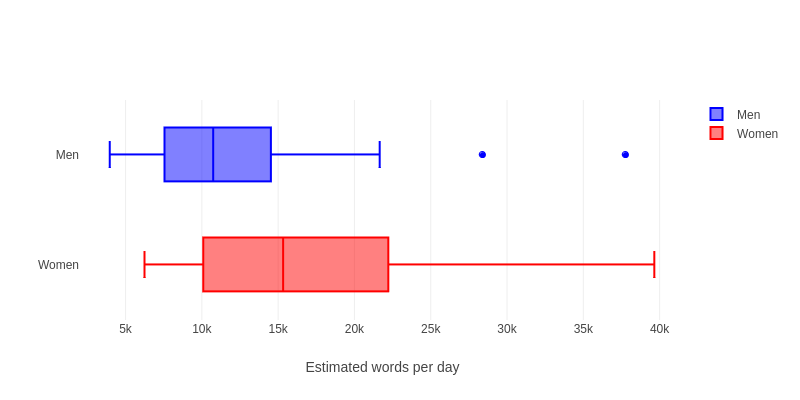
This picture suggests that there might be a difference between men & women, but is it really significant? Or could this just be a random fluke? To find out, we can do a two sample t-test.
Two-Sample Hypothesis Test for Means
You can use the smaller sample size minus one as the degrees of freedom.
Works best if the combined sample size is at least 30, or if there are no outliers and little skew in the data.
When you do a two sample t-test (or a 2-sample t-confidence interval), there is a complicated formula for the right degrees of freedom. But an easy safe approximation is this: in other words, use the smaller sample size minus 1 as the degrees of freedom.
Here is a quick summary of the numbers we need to calculate the t-value for the example with men & women talking.
| Women | 27 | 16,496.1 | 7,914.3 |
| Men | 20 | 12,866.7 | 8,342.5 |
Cloud Seeding. An experiment done in the 1970’s looked at whether it is possible to spray clouds with a silver iodide solution to increase the amount of rain that falls in an area. On 26 days with promising clouds a plane sprayed the clouds with silver iodide solution and on 26 similar days they didn’t spray. The amount of rainfall (measured in acre-feet) was tracked by radar. Here were the results:
| Seeded | 26 | 442.0 | 650.8 |
| Control | 26 | 164.6 | 278.4 |
| Day | Section | Topic |
|---|---|---|
| Mon, Apr 13 | 7.4 | Statistical power |
| Wed, Apr 15 | Review | |
| Fri, Apr 17 | Midterm 3 |
Today we introduced the 2-sample confidence interval for means.
Two Sample Confidence Interval for Means
Use this to estimate the gap between two population means.
You can use the smaller sample size minus one as the degrees of freedom to find .
Works best if the combined sample size is large () or there is very little skew and no outliers in either sample.
These formulas (both the two-sample t-test and t-confidence interval) are based on the same key assumptions.
No Bias. As always, we need good simple random samples to avoid bias.
Normality. The t-distribution methods are based on the normal distribution. If the sample sizes are big enough, then you don’t need to worry to much about normality. Two-sample t-distribution methods are very robust, which means they tend to work well even with data that isn’t quite normal.
After that, we did this workshop in class.
Today we talked about the midterm 3 review problems. We also talked about how to choose the right inference method. Ask these three questions to decide which interference formula to use:
The answer to these three questions will guide you to the right formula to use.
| Day | Section | Topic |
|---|---|---|
| Mon, Apr 20 | 6.3 | Chi-squared statistic |
| Wed, Apr 22 | 6.4 | Testing association with chi-squared |
| Fri, Apr 24 | Choosing the right technique | |
| Mon, Apr 27 | Last day, recap & review |
This week we are going to introduce one more inference technique known as the chi-squared test for association. The statistic let’s you measure if an association between two categorical variables is statistically significant. Before we talked about the statistic, we looked at two-way tables. We talked about how to find row and column percentages in a two-way table.
The 2003-04 National Health & Nutrition Exam Survey asked participants how they felt about their weight (options were “underweight”, “about right”, or “overweight”). The results are shown in the two-way table below, broken down by gender.
| Female | Male | Total | |
|---|---|---|---|
| Underweight | 116 | 274 | 390 |
| About right | 1175 | 1469 | 2644 |
| Overweight | 1730 | 1112 | 2842 |
| Total | 3021 | 2855 | 5876 |
What percent of women said that they felt overweight?
What percent of overweight people were women?
An association between two categorical variables is statistically significant if there is strong evidence that the association holds in the population, not just in the sample. In a χ² test, you always test the following hypotheses:
To determine whether or not to reject , use a computer to find the statistic for the two-way table. If is true, then the statistic should follow a χ² distribution with degrees of freedom equal to: You can use the χ² distribution app to find the corresponding p-value.
The two-way table above has a chi-squared statistic of . How many degrees of freedom does the table have and what is the corresponding p-value?
Is the association between gender and perceived body weight statistically significant?
A study from the 1990s looked at whether the anti-retroviral drug AZT can help prevent pregnant women with HIV from passing the virus on to their children. The mom’s were randomly assigned to receive either AZT or a placebo, and the results are shown in the two-way table below.
|
HIV-positive baby |
HIV-negative baby |
|
|---|---|---|
|
AZT |
13 |
167 |
|
Placebo |
40 |
143 |
This table has . Is this strong evidence that AZT works better than a placebo? G
Today we talked some more about the -test for association. We mentioned that the -distribution has these features:
The assumptions for the -test are:
We did the following example where the -test is inconclusive:
The 2008 General Social Survey asked people if they were “very happy”, “pretty happy”, or “not too happy” with their lives. Here are the results broken down by gender.
|
Female |
Male |
|
|---|---|---|
|
Very Happy |
271 |
328 |
|
Pretty Happy |
513 |
587 |
|
Not Too Happy |
142 |
174 |
This table has . Is there a statistically significant association between the two variables in this two way table? What are the two variables?
Today we talked some more about how to choose the right inference technique.
Workshop: Choosing the right technique
Today we went over answers to the review questions for the final exam.